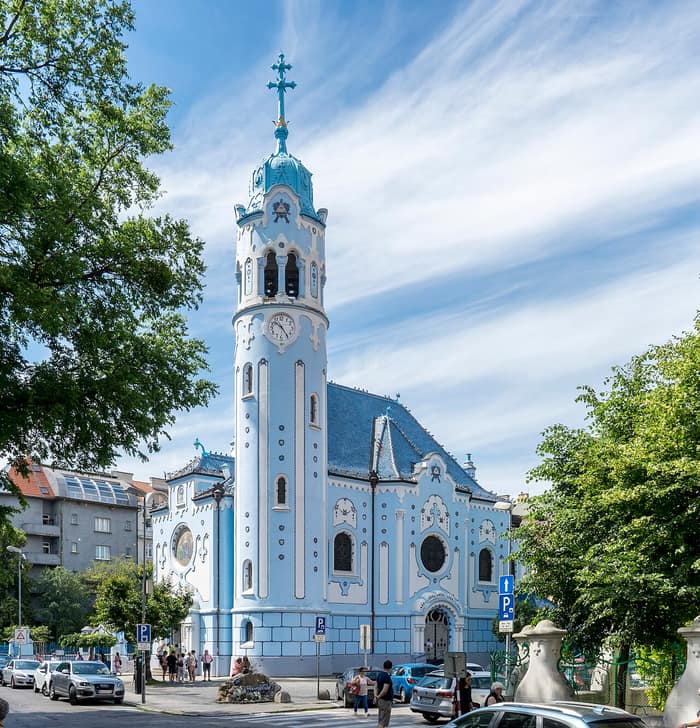
The Blue Church in Bratislava: Ödön Lechner's little jewel
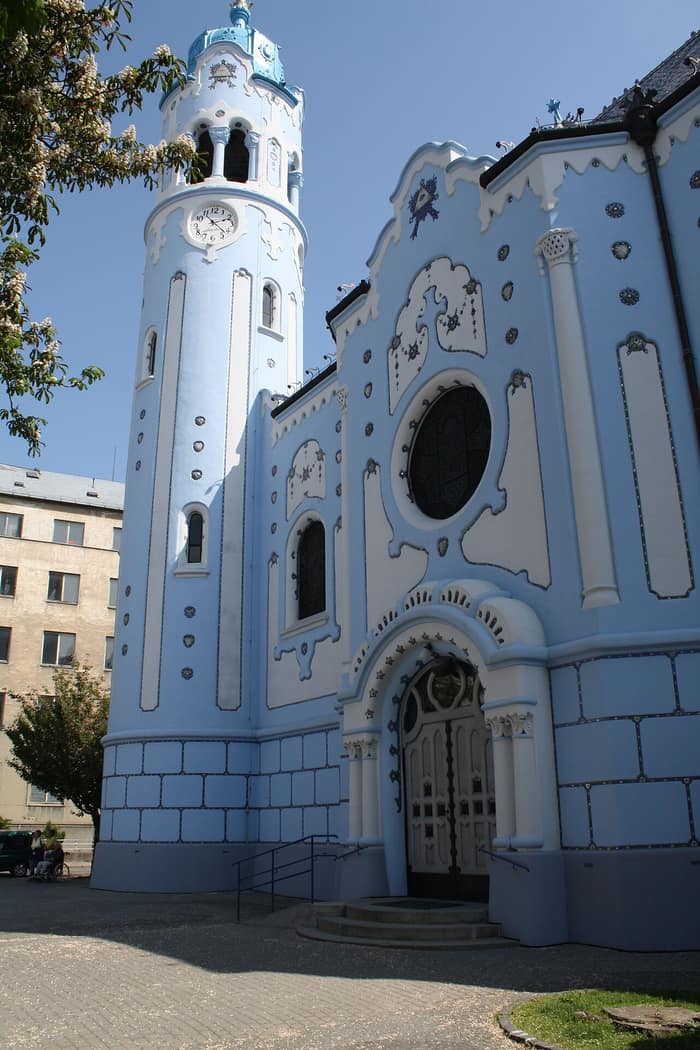
The Church of St Elisabeth (Kostol svätej Alžbety), known to everyone as the Blue Church, stands in the eastern part of Bratislava's Old Town. Built in 1909–1913 to a design by the Budapest architect Ödön Lechner, it is a small, single-nave church in Hungarian Secessionist style with a blue façade, blue mosaics and a blue glazed roof, and one of the most photogenic Art Nouveau buildings in the city.
A school chapel that looks like a piece of blue confectionery: the church has a dome that was never built, a mini-dome hidden above the pulpit and a roof of glazed tiles.
The history of the Blue Church in Bratislava
At the turn of the 19th and 20th centuries Bratislava, then known as Pressburg, grew mainly towards the east. A new quarter named after Emperor Franz Joseph began to take shape there, with a royal Catholic grammar school, a parish house and a church. The first plan foresaw only a small chapel next to the school, but thanks to the efforts of Countess Mária Gabriella Szapáry a larger church was built. The Hungarian minister of religion and education, Albert Apponyi, commissioned Ödön Lechner, one of the leading figures of Hungarian Art Nouveau, to design the whole ensemble. The school was finished in 1906–1908, and the first plans for the church are said to date from around 1903–1904.
The foundation stone was laid on 23 August 1909 by Simon Való on behalf of the Archbishop of Esztergom. The foundation document was prepared on prepared skin by the school's teacher Jozef Volker. It shows St Elisabeth in the middle, the plan of the church, the school building and the silhouette of St Martin's Cathedral, and bears the words: “Take off your hat, mortal, for the place where you stand is holy.” The construction was led by the Bratislava builder Anton Durvay, and new materials such as reinforced concrete and artificial stone were used. The cross was raised on 26 June 1910, the bells were blessed on 14 May 1911 and the church was consecrated on 11 October 1913. Relics of St Elisabeth, together with those of St Clement, St Vincentia and St Theodora, were placed in the main altar.
The church is dedicated to Elisabeth of Hungary, daughter of King Andrew II, who is said to have grown up at Pressburg Castle. Contemporaries also saw it as a memorial church for Empress Elisabeth, murdered in Geneva in 1899. A white marble relief of the praying empress by the sculptor Alois Rigele was placed inside. After the First World War, amid strong anti-Hungarian feeling, it was removed; it was first taken to the Grassalkovich Palace and later to the parish house, where it remains.
For its first two decades the church served as the chapel of the neighbouring school. On 1 July 1934 it became an independent parish. The façade was at first painted in soft pastel colours and only later received its characteristic blue. In recent years the church and the parish house have been thoroughly renovated.
Curiosities about the Blue Church
- Lechner first planned a dome on an oval ground plan, but it was never built. Instead the church has a barrel vault under a steep hipped roof, and above the pulpit sits a tiny dome, an exact miniature of the one originally intended.
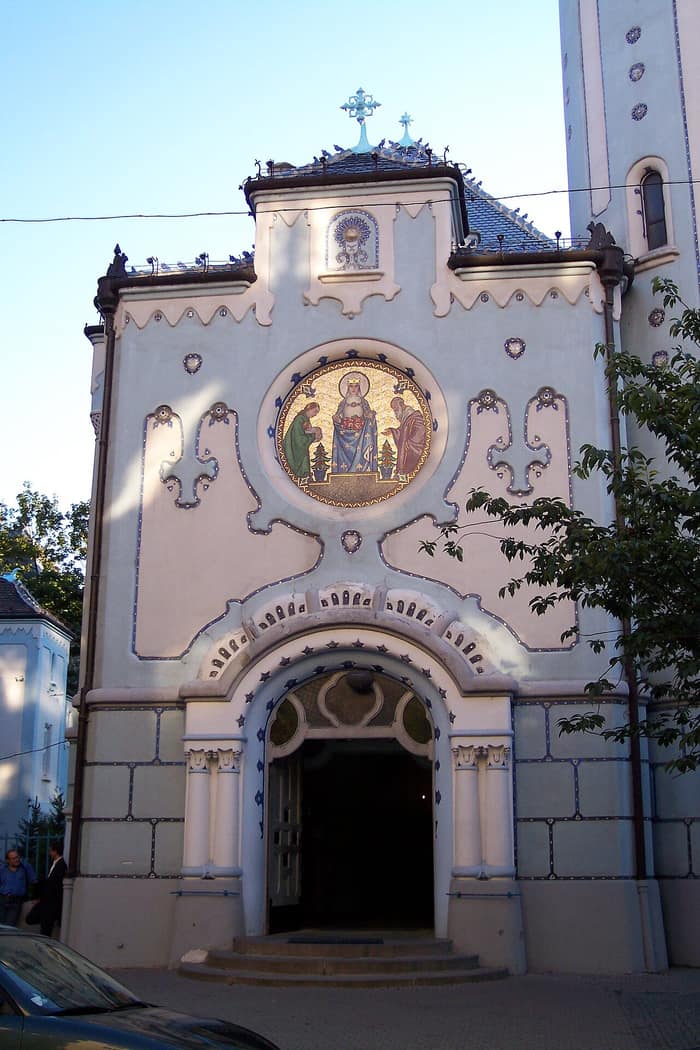
- The ornament is built around the rose, the flower of the legend of St Elisabeth, whose alms for the poor were said to turn into roses in a moment of danger. A round mosaic above the entrance shows this “miracle of the roses”.
- The foundation document, written on prepared skin, carries the inscription “Take off your hat, mortal, for the place where you stand is holy”.
- The roof is covered with glazed tiles, and a model of the church stands in the Mini-Europe park in Brussels, where it represents Slovakia.
- Lechner even designed the eternal lamp, made of silver and red glass and hung from the chancel arch on chains decorated with a lily crown.
- The architect Marcell Komor described the church as a “new jewel box” of Hungarian culture.
Tours near Church of St Elisabeth (Blue Church)
Experiences in the area that you can book online with Viator:


Visiting the Blue Church in Bratislava
- The church stands on Bezručova ulica in the east of the Old Town, together with Lechner's gymnasium on Grösslingová ulica and the parish house, which form one compact Art Nouveau ensemble.
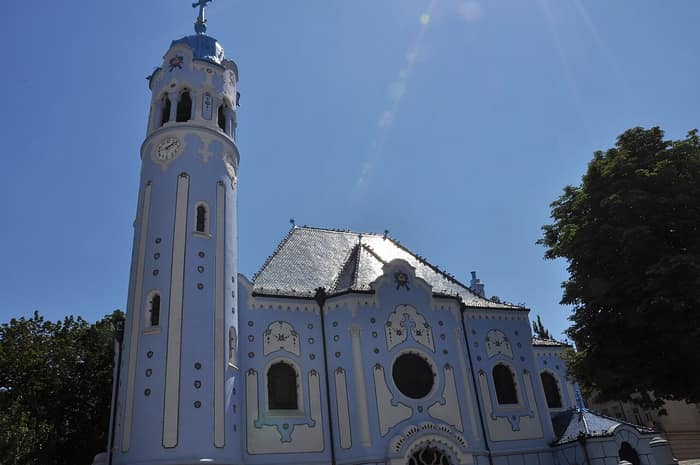
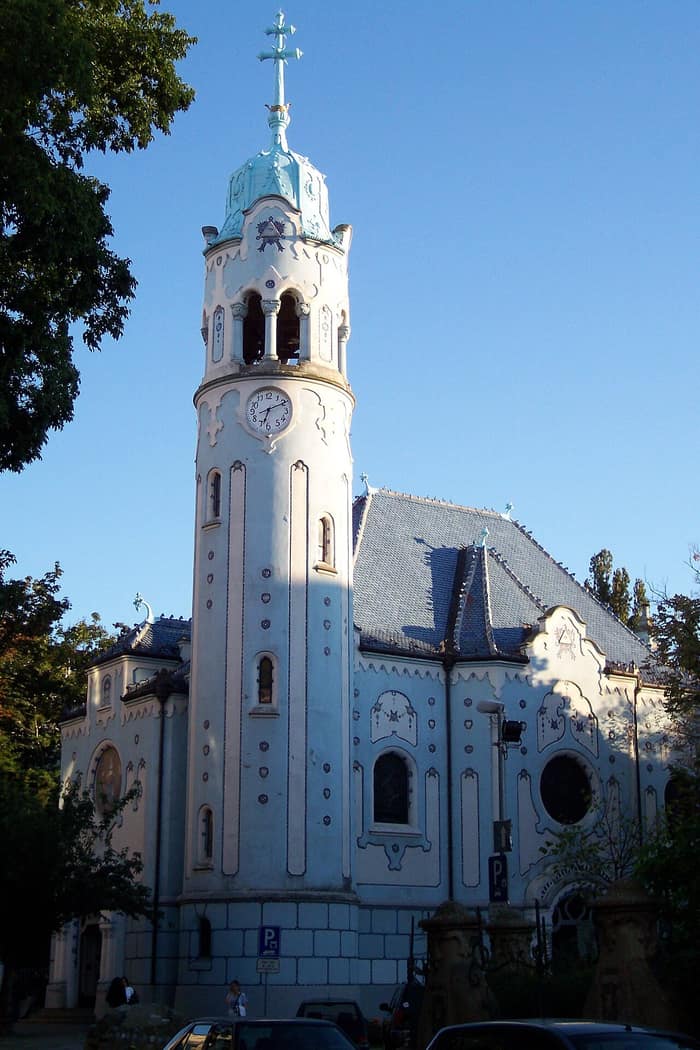
- Look at the exterior details: the cylindrical tower, the double columns at the main and side entrances, the wave-shaped band of blue tiles and the Italian mosaic of St Elisabeth over the main door.
- Inside, the altar painting of St Elisabeth giving alms was painted by Gyula Túry in 1911; look also for the paintings of Árpád saints, the reliefs by Alois Rigele and the blue vault patterned with roses.
- The church is small, so a visit takes little time. Check the current opening hours before you go, as the interior is not always open to visitors.
- Other places on this site within about a kilometre include Laurinc Gate, Aspremont Palace, the Clarissine Church and Esterházy Palace.
Opening hours, access and conditions can change. Check before you go.
Map: where Church of St Elisabeth (Blue Church) is
Photos of Church of St Elisabeth (Blue Church)
Questions
Where is the Church of St Elisabeth (the Blue Church) in Bratislava?
It stands on Bezručova ulica in the eastern part of Bratislava's Old Town, next to the Grösslingová gymnasium that Ödön Lechner also designed.
Why is it called the Blue Church?
The name comes from the blue colour of its façade, mosaics, ceramic details and glazed roof. The façade was at first painted in pastel colours and only later became blue.
Who designed the Blue Church?
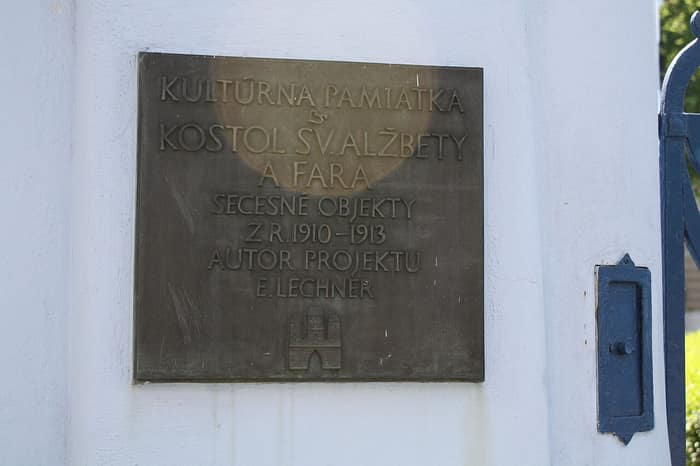
The Budapest architect Ödön Lechner, one of the leading figures of Hungarian Art Nouveau, designed the church, the neighbouring school and the parish house. The church was built in 1909–1913.
Who is the church dedicated to?
It is dedicated to Elisabeth of Hungary, daughter of King Andrew II, who is said to have grown up at Pressburg Castle. Many people also saw it as a memorial to Empress Elisabeth.
What is special about the architecture?
It is a small single-nave church with a cylindrical tower, a roof of glazed tiles, Romanesque-style double columns and flowing Secessionist lines. The planned dome was replaced by a barrel vault.
Is the Blue Church worth a visit?
Yes, for anyone interested in Art Nouveau. It is compact and close to the centre, and it can easily be combined with a walk through the Old Town.
Also nearby
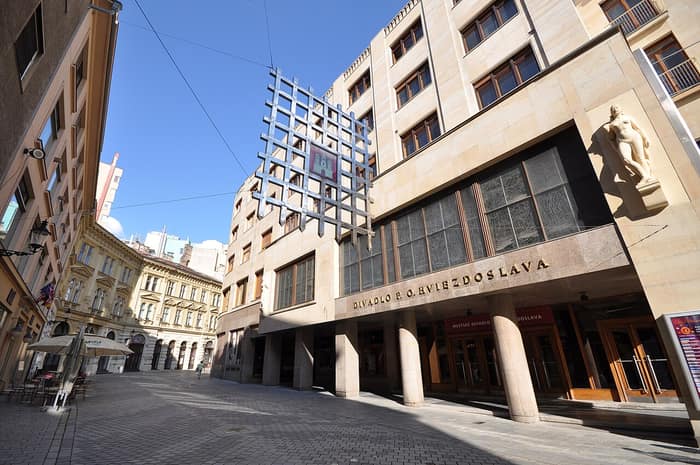
Laurinc Gate
Bratislava · vanished medieval gate marked by a hanging portcullis
450 m away
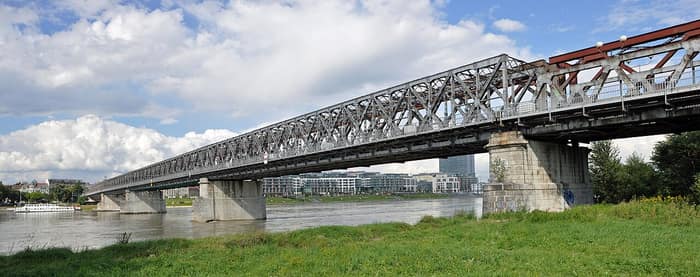
Starý most
Bratislava · Danube bridge that changed names and shape
550 m away
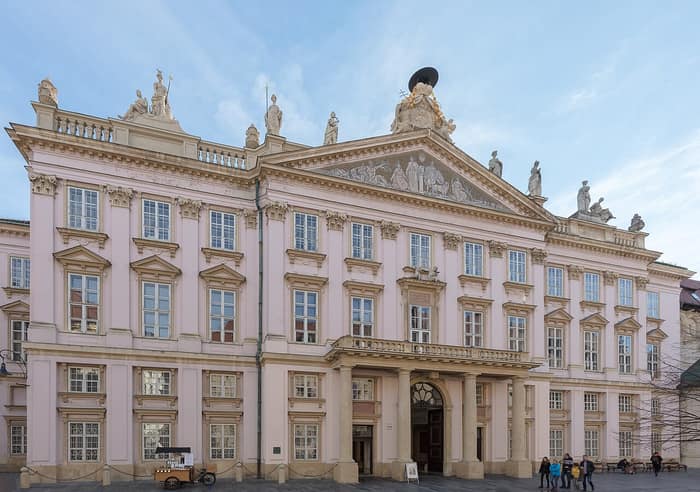
Primate's Palace
Bratislava · palace where the 1805 peace was signed
600 m away
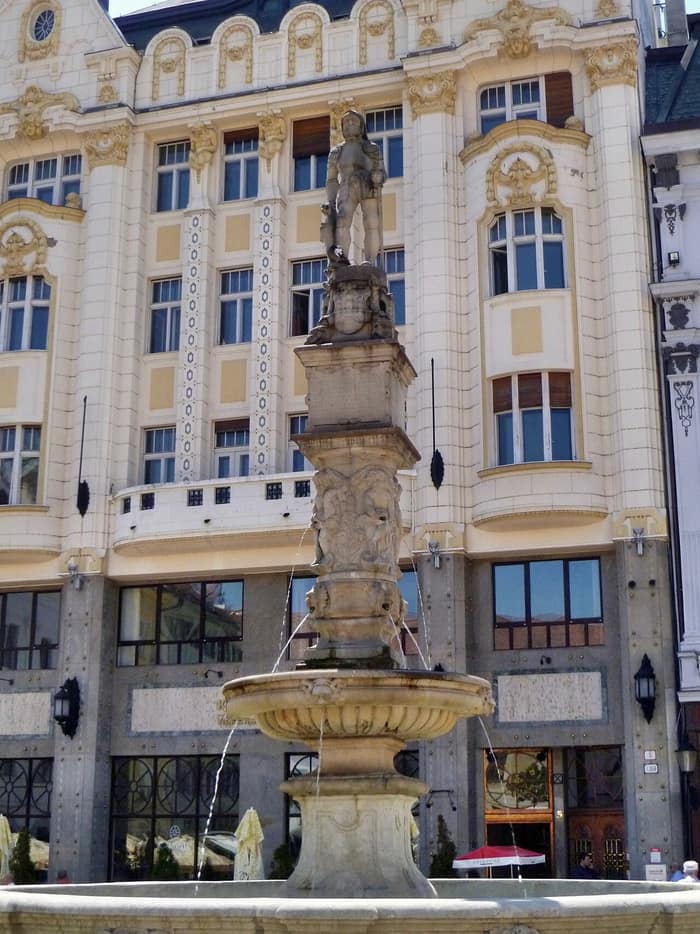
Roland Fountain
Bratislava · the 1572 fountain where a king plays the knight
650 m away